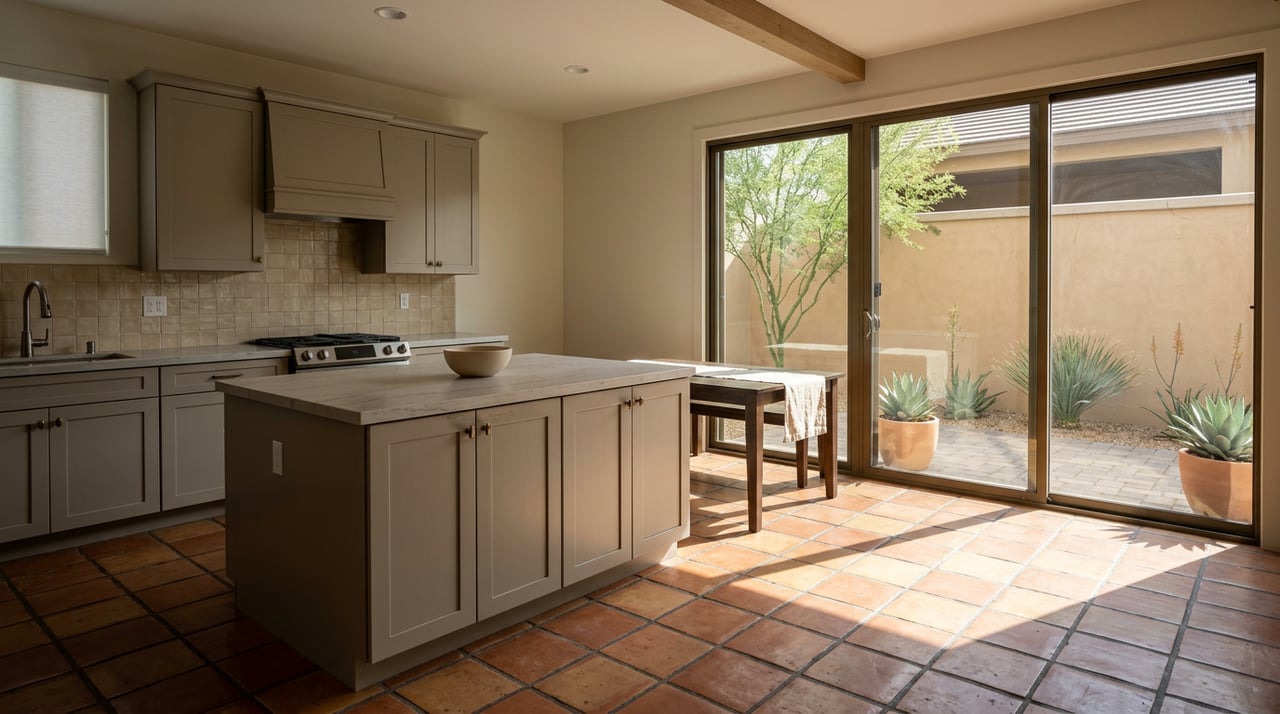
What Sahuarita CFD Property Tax Means for Buyers
August 20, 2026
August 20, 2026
You're three pages into the Arizona Seller's Property Disclosure Statement, past the roof and the plumbing and the pool barrier, when you hit a question that doesn't sound like the others: is this property located within the boundaries of a Community Facilities District? Most buyers pause here. Some skip it entirely and ask their agent later, usually after they've already fallen for the floor plan. In Rancho Sahuarita or Quail Creek, that pause is worth taking seriously, because the answer changes what you actually pay every year to live there, on top of the mortgage and on top of the HOA bill you already budgeted for.
This is not a story about whether Sahuarita is a good place to buy. The market data says it is: 148 homes closed in July 2026 at a median sale price of $371,000, up from $335,000 over the trailing twelve months, a $36,000 lift, with homes moving in a median of 51 days. The 85629 zip code, which covers most of incorporated Sahuarita, ran a bit higher at $374,000. This is a story about a line item that sits inside that median price and gets treated as fine print when it should be treated as a real number.
A CFD is a public financing tool. A developer wants to build roads, drainage, sewer lines, and landscaping for a large master-planned community before enough rooftops exist to pay for it the traditional way. Instead of folding those costs into the price of every lot, the town forms a separate taxing district, that district issues bonds, and the bonds get repaid over decades by the property owners who move in later. The pitch, made plainly by Rancho Sahuarita's own managing partner when KB Home broke ground on the Entrada Del Toro neighborhood in August 2024, is that this structure keeps the sticker price of the home lower than it would otherwise be. Without it, he argued, the infrastructure cost would show up in the price of the house instead, likely putting it out of reach for more buyers.
That trade is real, and it isn't hidden. It's just easy to miss until it's spelled out.
Rancho Sahuarita's CFD was formed by the Town of Sahuarita on March 24, 2014. The district's current list of approved improvements runs $38.6 million, with a ceiling of $60 million in general obligation bonds over a 35-year period. This isn't a one-time historical footnote. The district's own Fiscal Year 2026 tentative budget, adopted by the CFD's governing board, comes in at $9,233,410, meaning the assessment is still an active, funded line on current tax bills, not a legacy charge that's winding down.
Quail Creek has its own, older CFD, formed in 2005 with an initial bond issue of $12.66 million in 2006 that funded Campbell Avenue, the Campbell Avenue bridge, Quail Creek Parkway, drainage work, sewer improvements, and Quail Creek Veterans Municipal Park. The two districts are not identical in cost. When Rancho Sahuarita's CFD was proposed, the rate on the table was $5.30 per $100 of assessed valuation, split between $5.00 for debt service and $0.30 for operations and maintenance. At the time, town estimates showed that rate adding roughly $900 a year to the tax bill on a $200,000 home, moving it from about $2,340 to about $3,240. Quail Creek's district, by comparison, was set up with a lower combined rate of $3.30 per $100, split $3.00 for debt service and $0.30 for operations and maintenance.
The gap between those two rates is the reason two homes with similar list prices in the same town can carry noticeably different annual tax bills, and it's exactly the kind of detail that never shows up on a listing sheet.
Here's where the comparison gets more useful, and more commonly confused. A CFD assessment and an HOA due are two separate charges that fund two separate things, and Sahuarita's two biggest master-planned communities have built very different amenity packages on top of their tax structures.
Rancho Sahuarita's master HOA dues typically run $200 to $300 per quarter. That fee gets a resident into Club Rancho Sahuarita, the Ventana Fitness Center, the Splash Park, satellite pools at Parque Del Rio and Parque Del Presidio, more than 25 miles of trails including the Safari Trail, lined with life-size bronze animal statues, and the Anza Trail, a designated segment of the Juan Bautista de Anza National Historic Trail. Sahuarita Lake itself sits at the center of the community next to the Club, with a mile-long path that a lot of residents use to start their day.
Quail Creek runs on a different model entirely. It's the only resort-style, age-restricted community south of Tucson, and its dues reflect that: typically $350 to $500 per month, bundling access to the Canyon Club, which passed its one-year anniversary in April 2026, 27 holes of golf, 32 pickleball courts, the Madera Clubhouse, and the Anza Athletic Club.
Neither structure is better on its face. But stack each community's HOA number next to its CFD rate and you get two very different total carrying costs for what might look, on a listing photo, like comparable homes.
| Community | Master HOA Dues | What It Funds | CFD Rate (per $100 assessed value) |
|---|---|---|---|
| Rancho Sahuarita | $200 to $300 per quarter | Club Rancho Sahuarita, Sahuarita Lake, 25+ miles of trails, fitness center, pools | $5.00 debt service + $0.30 operations (as originally set) |
| Quail Creek | $350 to $500 per month | Canyon Club, 27 holes of golf, 32 pickleball courts, Madera Clubhouse, Anza Athletic Club | $3.00 debt service + $0.30 operations |
Read the table as a trade, not a ranking. Rancho Sahuarita asks less per quarter in dues but carries the higher CFD rate. Quail Creek asks more per month in dues but carries the lower CFD rate. A buyer comparing the two on price per square foot alone is missing half the math.
Seven active builders are working across Rancho Sahuarita and Quail Creek as of this summer, including KB Home, Meritage, Lennar, Centex, and Richmond American. Meritage has flagged its Entrada del Pueblo product as "last chance to own" this cycle, which means close-out pricing and incentive structures are shifting fast enough that a buyer comparing two builders' base prices this month could be looking at different numbers next month. In a market where 148 homes closed in a single month and days on market sit at 51, decisions are happening quickly. That's precisely the environment where a buyer skims the SPDS instead of reading it, because the house down the street just went under contract and there's pressure to move.
It's worth remembering that the Town of Sahuarita itself levies zero town-level property tax and charges no impact fees. That fact, true and worth knowing, can create a false sense that taxes here are uniformly low. They are, on the base rate. The CFD assessment sits entirely outside that base rate, tied to the specific master-planned community and sometimes the specific phase of construction within it.
The Pima County Treasurer's office publishes the actual assessments tied to any specific parcel, searchable by state code and tax area. Pull that before writing an offer, not after. Ask your builder or listing agent for the full CFD and HOA disclosure packet up front, and compare it line by line against a home in a different village, even one you're not seriously considering, just to see the shape of the trade. The house with the lower CFD rate and higher monthly dues, and the house with the higher CFD rate and lower quarterly dues, can land in the same place over a decade. They rarely land there by accident, and they almost never land there if you only compare the sticker price.
Does every home in Rancho Sahuarita sit inside the CFD boundary? Not necessarily. The original 2014 district was structured to tax the portions of the community that were not yet built at the time of formation. Boundaries are parcel specific, which is exactly why pulling the Pima County Treasurer record for the actual address matters more than assuming based on the community name.
Is Quail Creek open to any buyer, or is it age restricted? Quail Creek operates as a resort-style, age-restricted 55-plus community, the only one of its kind south of Tucson.
Does the Town of Sahuarita charge its own property tax on top of the CFD? No. The town itself levies no property tax and no impact fees. Everything a Sahuarita property owner pays goes to entities other than the town, including the school district, fire district, Pima County, and, where applicable, the CFD.
If you're comparing Rancho Sahuarita, Quail Creek, or any other Sahuarita master plan and want the actual disclosure numbers pulled for a specific address before you write an offer, that's exactly the kind of homework Urban Oak Partners does before a client ever sits down at a title company. Reach out to Blaire Lometti for a free home valuation and a straight answer on what a specific property's tax bill actually looks like once the CFD line is added in.

As your trusted real estate agent, I provide expert support whether you’re buying or selling. My goal is to make your transaction effortless and deliver the results you deserve, with a focus on your unique needs and goals.